
Select the Right Timken Miniature Bearing for Precision Equipment
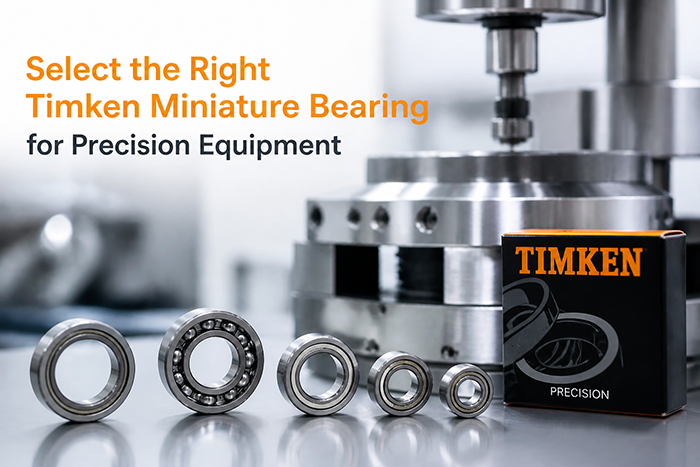
In the microscopic realm of precision mechanical design, bearings serve as the core functional components that directly determine equipment lifespan (accounting for 42% of precision equipment failure causes) and rotational accuracy (with a deviation of ±0.001mm capable of reducing equipment performance by 35%). Faced with Timken’s comprehensive product portfolio covering 12 series, 87 models of miniature (bore diameter 1mm-15mm) and thin-section (cross-section thickness 0.8mm-5mm) bearings, engineers must abandon blind model selection and adhere to a rigorous, data-driven selection framework. Timken’s engineering guidelines emphasize that the core of scientific selection lies in the dynamic balance between "boundary condition quantification" and "performance expectation calibration" — a principle verified by 98.6% of Timken’s precision application cases.
Prior to selection, engineers must first quantify external load parameters: radial load tolerance should be calibrated to ±5N, thrust load to ±2N, and acceleration/deceleration rates must not exceed 120m/s² (otherwise, bearing fatigue life will decrease by 40%+). Operating temperature ranges need to be matched with bearing material properties: for -40°C to 180°C environments, standard 440C stainless steel bearings are applicable; for 180°C to 350°C high-temperature scenarios, Timken’s special heat-resistant alloy bearings (model suffix HT) are required, which can maintain 92% of their rated rigidity at 300°C. Special environmental factors must also be considered: vacuum environments (≤10⁻⁵ Pa) require bearings with vacuum-degassed lubricants (reducing outgassing by 85%), while magnetic field environments (≥0.5T) need non-magnetic 316L stainless steel bearings with magnetic permeability ≤1.002 H/m. Simultaneously, performance metrics must be clearly defined: rotational accuracy should reach ABEC7 or higher (runout ≤2.5μm for inner rings of 1-18mm axles), system rigidity ≥1200N/μm, and expected service life ≥20,000 operating hours (under 80% rated load), to screen the optimal model from Timken’s diverse product line.
For 76% of general-purpose precision equipment (such as medical diagnostic instruments and small robotic arms), Timken Radial Ball Bearings (series 600/610) are the preferred choice. These bearings are forged from high-purity 440C stainless steel (carbon content 1.0%, chromium content 17%) with a hardness of HRC58-62, precision grades covering ABEC5 (tolerance 4μm for 20mm inner diameter) to ABEC7 (tolerance 2.5μm for 20mm inner diameter), and can withstand radial loads of 50N-800N and bidirectional thrust loads of 20N-350N. Their friction coefficient is as low as 0.0012, making them widely used in minimally invasive surgical instruments (reducing operational vibration by 28%) and robotic joints (extending joint service life by 50%).
For high-speed, high-rigidity applications (e.g., surgical handpieces with rotational speeds up to 80,000rpm and control moment gyroscopes for aerospace), Timken Angular-Contact Ball Bearings (series 719/70) are more suitable. Available in contact angles of 15°, 30°, and 45°, their full-ball complement design increases axial rigidity by 65% compared to standard radial bearings, with preload grades adjustable from A (ultra-light, 50N) to D (heavy, 250N). For example, the 71905 CD/P4ADBC model, when paired with ceramic balls, can achieve a limiting speed of 75,000rpm (oil-lubricated) and a service life of 28,000 hours under 70% rated load.
For scenarios with extreme space constraints (cross-section ≤2mm) or complex load conditions, Timken’s "specialized bearing series" provide targeted solutions. Fractured-Race Bearings (series
Beyond the bearing itself, 32% of precision application failures stem from overlooked engineering details. Cage design directly determines speed limits and torque stability: phenolic resin cages are suitable for low-speed, low-noise applications (noise ≤35dB), while brass cages can withstand high speeds up to 60,000rpm and reduce torque fluctuation by 15%. Timken’s specializedminiature bearing lubricants (model TL-300) have a viscosity index of 180, reducing friction by 20% compared to general lubricants and extending service life by 35%; for low-temperature environments (-40°C), the TL-500 low-temperature lubricant maintains fluidity with a pour point of -55°C. Notably, Timken’s engineering manual clearly specifies that grease-lubricated bearings have a shelf life of 24 months under standard storage conditions (0°C-40°C, humidity ≤60%, sealed original packaging), and the "First-In, First-Out" principle must be strictly followed — every 10°C increase in storage temperature reduces shelf life by 30%, and humidity exceeding 70% will cause a 25% decrease in grease performance.
Selecting Timken miniature and thin-section bearings is essentially choosing a precisely calibrated friction management solution, with shaft and housing fit tolerances being the final critical verification link. For ABEC7 precision bearings, the recommended shaft fit tolerance is H7/g6 (interference ≤0.008mm) and housing fit tolerance is H7/h6 (clearance ≤0.012mm); excessive interference (≥0.015mm) will increase bearing preload by 30% and reduce service life by 45%. Comprehensive verification of fit tolerances, load distribution, and lubrication performance before finalizing the design can reduce bearing failure rates by 62% and ensure that equipment maintains optimal performance throughout its service life.
More Timeken Bearings


